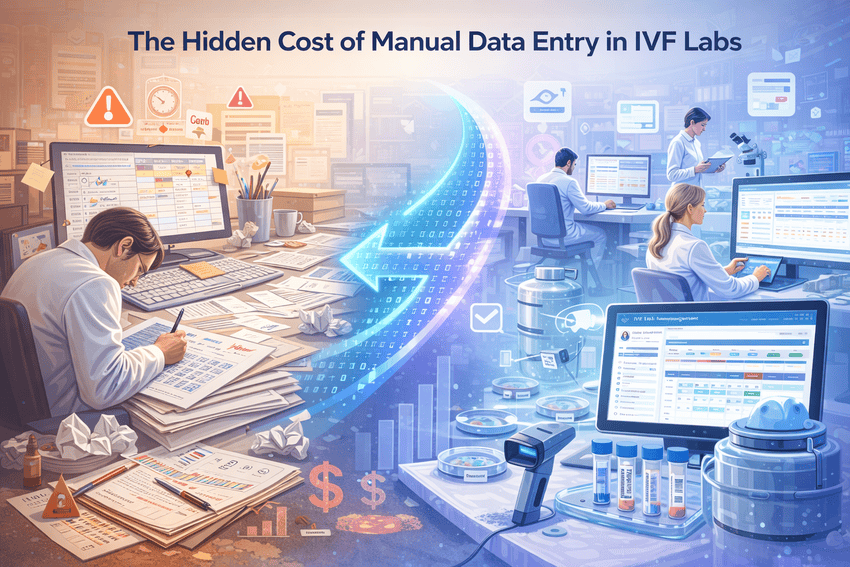
The Hidden Cost of Manual Data Entry in IVF Labs
In-vitro fertilization (IVF) laboratories operate in one of the most data-sensitive environments in healthcare. Every IVF cycle involves dozens of laboratory observations, patient records, embryo grading updates, and treatment milestones. These data points must be recorded accurately and consistently to ensure both clinical success and regulatory compliance.
However, many fertility clinics still rely on spreadsheets and manual documentation for recording laboratory data. While spreadsheets may appear simple and accessible, manual data entry in IVF labs introduces hidden operational costs that often go unnoticed.
These hidden costs include staff time spent on repetitive documentation, increased risk of human errors, difficulty maintaining sample traceability, and inefficiencies in laboratory workflows. As fertility clinics scale their operations and handle more treatment cycles, these issues become more significant.
Today, many clinics are addressing these challenges by adopting IVF lab management software and digital IVF lab systems. These platforms reduce the burden of manual documentation while improving workflow efficiency and data accuracy.
Manual documentation has long been a common practice in fertility clinics and embryology laboratories. Many IVF labs still rely on spreadsheets, handwritten logs, or disconnected systems to record patient information, embryo development data, and laboratory procedures. While this approach may appear simple and inexpensive, the hidden cost of manual data entry in IVF labs can be significant.
Every IVF treatment cycle involves multiple stages including ovarian stimulation monitoring, egg retrieval, fertilization tracking, embryo grading, cryopreservation, and embryo transfer. Each step generates critical data that must be accurately recorded and stored. When this information is entered manually into spreadsheets or paper records, clinics often face issues such as data inconsistencies, time-consuming administrative tasks, and increased risk of human error.
These challenges not only slow down laboratory workflows but can also impact clinical decision-making and regulatory compliance. As IVF clinics grow and handle larger volumes of treatment cycles, manual documentation becomes increasingly inefficient. Laboratory staff spend valuable time entering data rather than focusing on patient care and laboratory procedures.
To address these issues, many fertility clinics are adopting IVF lab management software and digital IVF lab systems. These platforms replace manual spreadsheets with integrated digital workflows that support real-time data tracking, automated documentation, and secure patient record management. By implementing a modern IVF laboratory information management system, clinics can significantly reduce administrative workload while improving accuracy and traceability.
Digital systems also enable better IVF lab workflow management, allowing embryologists and clinicians to access treatment information instantly. With integrated IVF sample traceability software and automated laboratory records, clinics can ensure that every egg, sperm sample, and embryo is accurately tracked throughout the treatment process.
Ultimately, eliminating manual data entry is not just about improving efficiency. It is about building safer, smarter, and more reliable IVF laboratories that support better outcomes for both clinics and patients.
Table of Contents
Understanding Manual Data Entry in IVF Labs
What Are the Hidden Costs of Manual Data Entry?
Human Errors and Data Accuracy Risks
Time Loss and Administrative Overload
Impact on Sample Traceability
Workflow Inefficiencies in IVF Laboratories
How IVF Lab Management Software Solves These Problems
Role of Automation in IVF Data Management
Manual Data Entry vs Digital IVF Lab Systems
Benefits of Eliminating Manual Data Entry
Choosing the Right IVF Digital System
FAQs
Conclusion
Understanding Manual Data Entry in IVF Labs
Manual data entry refers to the process of recording laboratory information by hand or through spreadsheets without automated system integration. In many fertility clinics, embryologists manually document treatment details such as fertilization results, embryo grading, cryopreservation status, and laboratory observations.
Although this approach may seem straightforward, IVF laboratories generate large volumes of data every day. Each treatment cycle requires multiple updates across different stages of the IVF process.
These records may include:
- Patient medical history
- Hormone stimulation tracking
- Egg retrieval documentation
- Fertilization results
- Embryo grading records
- Cryostorage inventory updates
When these data points are recorded manually, the chances of inconsistencies and errors increase significantly.
What Are the Hidden Costs of Manual Data Entry?
The costs associated with manual documentation are not always obvious. Many clinics assume that spreadsheets are inexpensive because they require no specialized software. However, the operational costs of manual documentation can accumulate over time.
Hidden costs include:
- Staff time spent on repetitive data entry
- Increased risk of documentation errors
- Difficulty locating historical patient data
- Complex compliance reporting requirements
- Limited visibility into laboratory workflows
These hidden costs can reduce laboratory efficiency and negatively affect the overall performance of fertility clinics.
Human Errors and Data Accuracy Risks
One of the most significant risks associated with manual data entry is human error. Even highly trained laboratory staff can make mistakes when entering large volumes of data.
Common data entry errors include:
- Incorrect embryo grading entries
- Duplicate patient records
- Missing treatment data
- Incorrect sample identification
- Misaligned spreadsheet columns
In IVF laboratories, even small documentation errors can have serious consequences. Accurate data tracking is essential for maintaining patient safety and ensuring successful treatment outcomes.
Time Loss and Administrative Overload
Embryologists and laboratory technicians are highly skilled professionals whose primary responsibility is patient care and laboratory work. However, manual documentation forces them to spend a large portion of their time on administrative tasks.
Repeated data entry into spreadsheets can significantly reduce productivity. Instead of focusing on laboratory procedures, staff members must constantly update records, verify information, and cross-check data.
This administrative burden can slow down laboratory operations and increase staff fatigue.
Impact on Sample Traceability
Accurate sample traceability is critical in IVF laboratories. Eggs, sperm, and embryos must be tracked throughout the treatment process to ensure they remain correctly matched to patients.
Manual tracking systems rely heavily on handwritten labels and spreadsheet entries. These methods increase the risk of sample misidentification.
Digital platforms provide IVF sample traceability software that automatically records sample movements, ensuring accurate documentation throughout the treatment cycle.
Workflow Inefficiencies in IVF Laboratories
Manual documentation often leads to fragmented laboratory workflows. Data may be stored in different spreadsheets or systems, making it difficult for staff to access information quickly.
Without integrated IVF lab workflow management tools, clinics may struggle to coordinate treatment steps efficiently.
Digital systems allow laboratories to monitor workflows in real time, ensuring that procedures are performed according to protocol.
How IVF Lab Management Software Solves These Problems
Modern IVF lab management software provides a centralized platform for managing laboratory data. Instead of relying on spreadsheets, clinics can document treatment cycles using structured digital systems.
These platforms often function as an IVF laboratory information management system (IVF LIMS) that supports:
- Automated laboratory documentation
- Integrated treatment cycle tracking
- Advanced reporting and analytics
- Secure patient data storage
- Real-time workflow monitoring
By implementing digital systems, fertility clinics can reduce manual workload and improve overall operational efficiency.
Role of Automation in IVF Data Management
Automation is becoming an essential component of modern IVF data management software. Automated systems reduce the need for manual documentation and ensure consistent record keeping.
Automation supports tasks such as:
- Embryo grading documentation
- Automated treatment cycle tracking
- Cryostorage inventory monitoring
- Digital reporting and analytics
These capabilities help laboratories maintain accurate records while reducing administrative workload.
Manual Data Entry vs Digital IVF Lab Systems
| Aspect | Manual Data Entry | Digital IVF Lab Systems |
|---|---|---|
| Data Recording | Spreadsheets and handwritten logs | Automated digital documentation |
| Sample Tracking | Manual labels | Automated traceability systems |
| Data Accuracy | High error risk | Automated validation |
| Workflow Visibility | Limited | Real-time monitoring |
| Compliance Reporting | Manual preparation | Automated reports |
Benefits of Eliminating Manual Data Entry
Replacing manual data entry with digital systems provides several advantages for fertility clinics.
- Improved laboratory efficiency
- Reduced risk of human error
- Better patient data management
- Enhanced regulatory compliance
- More accurate sample traceability
- Improved treatment outcome analysis
These benefits contribute to better patient care and more efficient clinic operations.
Choosing the Right IVF Digital System
Selecting the right digital platform is essential for clinics transitioning away from manual data entry.
Important factors to consider include:
- Compatibility with existing laboratory workflows
- Advanced sample traceability features
- Secure patient data storage
- Integration with clinical management systems
- User-friendly interface for laboratory staff
Choosing the right system ensures that the transition to digital platforms improves efficiency without disrupting clinic operations.
FAQs
1. Why is manual data entry risky in IVF labs?
Manual data entry increases the chances of human error and makes sample tracking more difficult.
2. What is IVF lab management software?
It is a digital system that helps fertility clinics manage laboratory workflows, patient data, and biological sample tracking.
3. How does automation improve IVF lab operations?
Automation reduces administrative tasks and ensures consistent documentation across treatment cycles.
4. Can digital systems improve sample traceability?
Yes. Digital traceability systems track biological samples using barcodes or other digital identifiers.
5. Are spreadsheets still used in IVF labs?
Some clinics still use spreadsheets, but many are transitioning to digital systems for better efficiency and compliance.
Conclusion
Manual data entry in IVF laboratories may appear cost-effective, but the hidden operational costs can significantly impact clinic efficiency and patient safety. As treatment volumes increase and regulatory requirements become stricter, relying on spreadsheets becomes increasingly unsustainable. An IVF software demo allows clinics to see how digital automation can reduce manual work, improve data accuracy, and streamline laboratory operations before adopting a complete solution.
By adopting fertility clinic software and modern digital IVF lab systems, fertility clinics can eliminate manual documentation challenges and build a more efficient, accurate, and scalable laboratory environment.