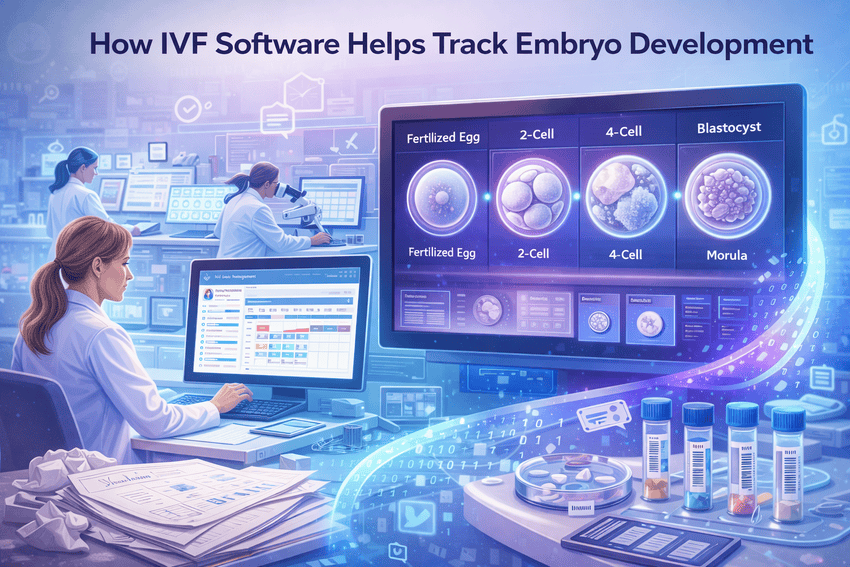
How IVF Software Helps Track Embryo Development
Tracking embryo development is one of the most critical aspects of modern IVF laboratories. During an IVF cycle, embryologists must carefully monitor fertilization, cell division, embryo grading, and developmental milestones. Every observation must be documented precisely to ensure accurate clinical decisions and successful treatment outcomes.
Historically, IVF labs relied on manual documentation methods such as spreadsheets, handwritten laboratory notes, and paper logs. While these methods worked in the early stages of fertility treatment, they are no longer suitable for modern IVF labs managing large volumes of complex treatment cycles.
Today, IVF lab management software and digital IVF lab systems allow fertility clinics to track embryo development with greater accuracy, automation, and traceability. These platforms often function as an IVF laboratory information management system (IVF LIMS), enabling embryologists to record observations, monitor embryo growth, and maintain a detailed digital history for every IVF cycle.
By replacing manual documentation with intelligent software solutions, IVF clinics can improve laboratory efficiency, reduce human error, and make better clinical decisions.
Table of Contents
Why Tracking Embryo Development Is Critical in IVF
Challenges of Manual Embryo Tracking
What Is IVF Software for Embryo Monitoring?
Key Features of IVF Software for Embryo Tracking
How IVF Software Improves Embryology Lab Workflows
Embryo Data Tracking and Reporting
Automation in Embryo Monitoring
Manual Tracking vs IVF Software
Benefits for Fertility Clinics and Patients
How to Choose IVF Software for Embryo Tracking
Future of Digital Embryology Monitoring
FAQs
Conclusion
Why Tracking Embryo Development Is Critical in IVF
Embryo development tracking plays a vital role in determining the success of IVF treatment cycles. After fertilization, embryologists closely monitor embryo growth through multiple stages including cleavage, morula formation, and blastocyst development.
Each stage provides critical insights into embryo quality and viability. Accurate documentation of these stages helps embryologists determine which embryos are suitable for transfer or cryopreservation.
Tracking embryo development also helps clinics:
- Monitor fertilization success rates
- Evaluate embryo quality
- Improve treatment protocols
- Analyze clinical outcomes
- Ensure proper documentation for regulatory compliance
Without structured tracking systems, maintaining consistent embryo development records becomes extremely difficult.
Challenges of Manual Embryo Tracking
Before digital IVF systems became common, embryologists often recorded embryo development observations using spreadsheets or paper laboratory logs.
While these tools were flexible, they presented several challenges:
- Human errors during data entry
- Difficulty maintaining consistent record formats
- Limited visibility across laboratory teams
- Time-consuming reporting processes
- Higher risk of missing or incomplete documentation
Manual records also make it harder to analyze embryo development trends across multiple treatment cycles. When data is scattered across spreadsheets, generating meaningful insights becomes complicated.
This is why many clinics are adopting IVF data management software designed specifically for embryology labs.
What Is IVF Software for Embryo Monitoring?
IVF software for embryo monitoring is a specialized digital system designed to track embryo development throughout the IVF cycle.
These systems typically operate as part of an IVF laboratory information management system (IVF LIMS). They allow embryologists to record embryo observations, monitor developmental milestones, and maintain detailed treatment records.
Modern systems can integrate multiple laboratory functions including:
- Embryo grading documentation
- Fertilization tracking
- Culture monitoring
- Cryopreservation records
- Embryology laboratory reporting
With centralized data management, IVF software provides a complete digital record of embryo development for each patient.
Key Features of IVF Software for Embryo Tracking
Modern embryology lab management software includes several powerful features that improve embryo monitoring.
- Digital embryo grading documentation
- Automated embryo development timelines
- Integrated patient treatment records
- Advanced reporting tools
- Secure laboratory data storage
- Real-time laboratory workflow tracking
These capabilities allow clinics to monitor embryo growth with greater accuracy while maintaining structured laboratory records.
How IVF Software Improves Embryology Lab Workflows
IVF laboratories involve complex workflows that require coordination between clinicians, embryologists, and laboratory technicians.
Digital IVF systems help streamline these workflows by automating documentation and improving communication between teams.
Benefits include:
- Standardized embryo grading protocols
- Real-time updates on embryo development stages
- Improved communication between lab staff and clinicians
- Reduced administrative workload for embryologists
By implementing structured IVF lab workflow management, clinics can maintain consistent procedures across all treatment cycles.
Embryo Data Tracking and Reporting
One of the biggest advantages of digital IVF systems is their ability to generate detailed embryo development reports.
With IVF lab data tracking, clinics can analyze embryo growth patterns across multiple treatment cycles. This data helps clinicians make more informed decisions regarding embryo transfer and cryopreservation.
Reporting capabilities may include:
- Embryo grading history
- Development stage timelines
- Laboratory performance metrics
- Success rate analysis
These insights allow clinics to continuously improve treatment protocols.
Automation in Embryo Monitoring
Automation is becoming increasingly important in IVF laboratories. Modern IVF lab automation software can automatically record embryo development stages and laboratory observations.
Automation helps reduce manual documentation while ensuring accurate record keeping.
Examples of automation include:
- Automatic embryo grading records
- Digital embryo development timelines
- Automated reporting for clinicians
- Integrated laboratory workflow monitoring
These technologies improve efficiency while reducing human error.
Manual Tracking vs IVF Software
| Aspect | Manual Tracking | IVF Software |
|---|---|---|
| Data Storage | Spreadsheets or paper | Centralized digital database |
| Embryo Tracking | Manual documentation | Automated embryo tracking |
| Reporting | Time-consuming | Instant digital reports |
| Workflow Management | Fragmented | Integrated workflow system |
| Data Accuracy | Higher risk of errors | Structured and validated |
Benefits for Fertility Clinics and Patients
Implementing IVF software provides significant advantages for both clinics and patients.
- Improved accuracy in embryo development tracking
- Better treatment documentation
- Enhanced patient safety
- Faster laboratory reporting
- Improved treatment outcome analysis
For patients, accurate embryo monitoring increases confidence in the IVF treatment process.
How to Choose IVF Software for Embryo Tracking
Selecting the right IVF software is an important decision for fertility clinics. Clinics should evaluate several factors when choosing a digital system.
- Compatibility with existing IVF workflows
- Advanced embryo tracking capabilities
- Secure patient data storage
- Ease of use for laboratory staff
- Integration with other clinic systems
Choosing the right platform ensures long-term efficiency and scalability.
Future of Digital Embryology Monitoring
The future of embryo monitoring is closely tied to technological innovation. Emerging technologies such as artificial intelligence and predictive analytics are already transforming IVF laboratories.
Future IVF systems may include:
- AI-assisted embryo grading
- Predictive success rate analysis
- Cloud-based IVF laboratory management platforms
- Integrated digital treatment workflows
These advancements will further improve embryo monitoring accuracy and clinical outcomes.
Common Challenges IVF Labs Face Without Digital Embryo Tracking
Many IVF laboratories still rely on spreadsheets or fragmented documentation systems for embryo monitoring. While these tools may appear convenient, they often create operational challenges that affect workflow efficiency and data accuracy.
Without structured IVF lab management software, clinics may experience difficulties in maintaining consistent embryo development records across multiple treatment cycles.
Some of the most common challenges include:
- Inconsistent embryo grading documentation: Manual records can lead to variations in grading standards across embryologists.
- Limited visibility of treatment cycles: When embryo data is stored across spreadsheets, it becomes difficult for clinicians to quickly access complete laboratory records.
- Time-consuming reporting: Generating embryo development reports manually requires significant administrative effort.
- Higher risk of human error: Manual data entry increases the possibility of incorrect or incomplete laboratory documentation.
- Difficulty analyzing embryo development trends: Without centralized IVF data management software, identifying patterns across treatment cycles becomes challenging.
Digital systems eliminate these problems by providing structured embryology lab management software that automates embryo tracking, standardizes documentation, and improves laboratory efficiency. By implementing modern digital IVF lab systems, fertility clinics can ensure accurate embryo monitoring while supporting better clinical decision-making.
FAQs
1. What is IVF software used for embryo tracking?
IVF software records embryo development stages, tracks laboratory observations, and manages treatment data throughout the IVF cycle.
2. Why is embryo tracking important in IVF?
Embryo tracking helps embryologists identify healthy embryos and make informed decisions about embryo transfer.
3. Can IVF software reduce laboratory errors?
Yes. Digital systems reduce manual data entry errors and ensure accurate documentation.
4. What is IVF LIMS?
IVF LIMS is a laboratory information management system designed specifically for fertility clinics.
5. How does automation improve embryo monitoring?
Automation records embryo development stages automatically, reducing manual documentation work.
Conclusion
Tracking embryo development is a critical component of successful IVF treatment. Manual documentation methods are no longer sufficient for modern fertility clinics managing complex laboratory workflows.
By adopting digital systems, clinics can monitor embryo growth more accurately, improve laboratory efficiency, and generate valuable treatment insights. Modern IVF platforms enable structured documentation, advanced reporting, and automated embryo tracking.
As IVF technology continues to evolve, implementing reliable fertility clinic software will play a key role in improving embryo monitoring, enhancing patient safety, and supporting better reproductive outcomes.